
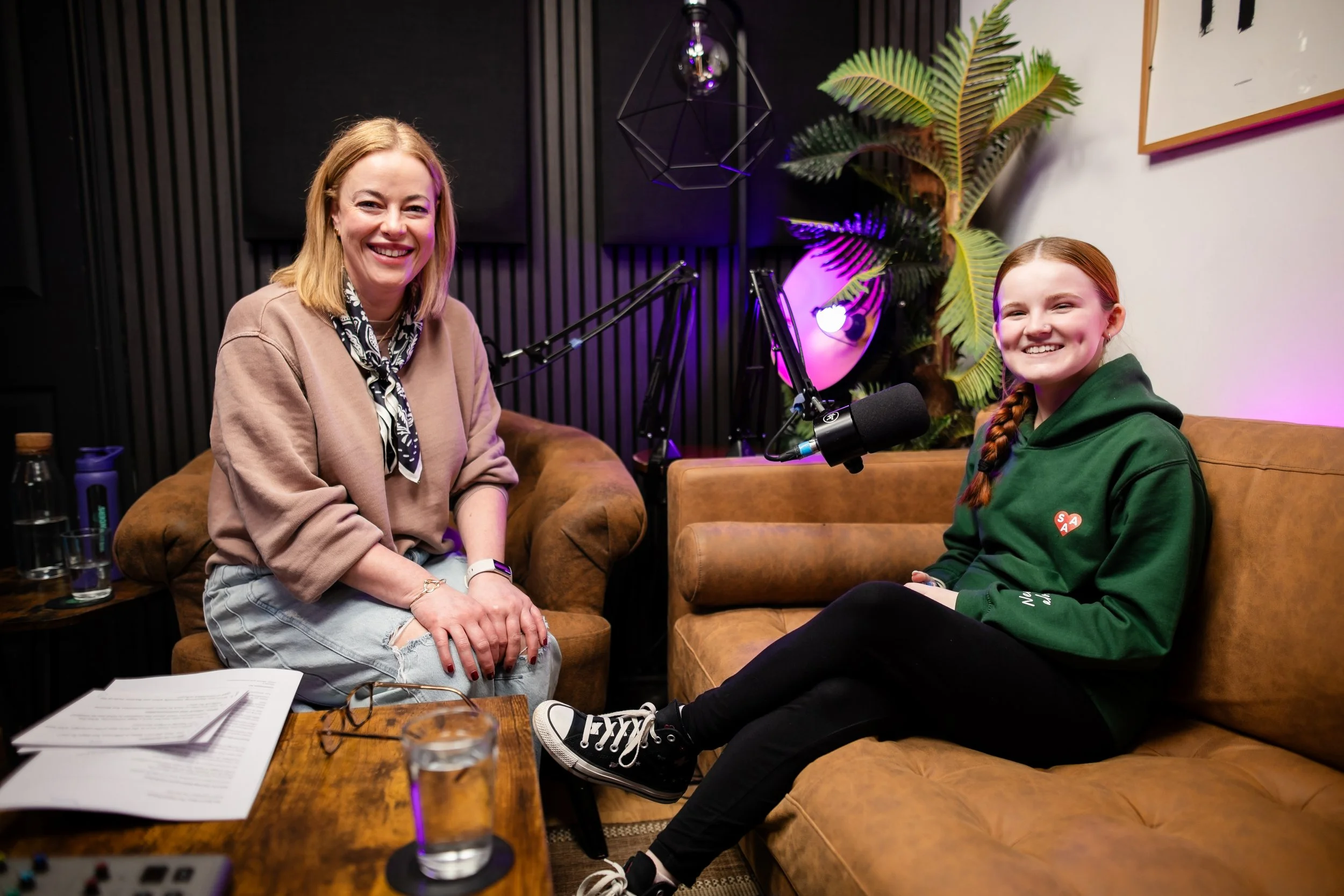
Different, Not Less:
Communication, Selective Mutism, and Finding Your Voice
with Eve Harrison
Different, Not Less: Communication, Selective Mutism, and Finding Your Voice with Eve Harrison
What happens when you walk into a new environment and your voice simply disappears? Not because you are shy, not because you have nothing to say, but because your nervous system has made a decision your words cannot override? This episode explores the experience of selective mutism in autism, BSL as a communication pathway, and the grassroots movement built by Eve Harrison, all captured in a conversation that stays with you long after you press pause.
What Selective Mutism Actually Feels Like
Selective mutism is not shyness. It is not a choice. For Eve, it meant starting secondary school and not speaking, not sometimes, but completely, for months at a time. She describes monitoring whether she was blinking enough, whether she was breathing in the right places, running every automatic social signal as a conscious, exhausting calculation. The episode gives this experience its proper name, and its proper weight.
How BSL Changed Everything
During the pandemic, Eve learned British Sign Language. That decision gave her something she had not had for years: a way to ask for help, to tell someone she felt unwell, to join a conversation in a classroom. These are small things. They are also the everything things. This conversation traces how that one communication shift rebuilt her ability to connect, advocate, and eventually reach over a million people.
Being Bullied for the Tool That Was Helping
When Eve returned to school using BSL, she was told by a SENCo and deputy head to stop flapping her hands about and learn to use her words. She was building three-word sentences at the time. This part of the conversation is uncomfortable to hear, and it needs to be heard. It is a precise and recent example of how the education system fails neurodivergent young people even when those young people are doing everything right.
The Neurodivergent Children Who Appear to Be Coping
Some of the most overlooked children in any school are the ones who seem fine. They sit quietly. They do not cause disruption. They are, in Eve's words, disappearing on the inside. This episode names the particular danger of quiet struggle, the children who are managing everything internally and receiving no support because they have not triggered any visible alarm.
The Grief and Relief of a Late Autism Identification
For years, Eve's school told her mum she had earache. She did not have earache. Her ears hurt because of the acoustics. When her autism was identified, that pain finally had a reason. Eve describes diagnosis as finally belonging somewhere, finally fitting, not being different for no reason, but being different for a very real one. The episode holds both the grief of the years before and the relief of finally having a framework.
What the SEND White Paper Gets Right, Gets Wrong, and Fails to Name
Eve and Emma move through the SEND white paper with the clarity that only lived experience can bring. Eve is direct: teachers desperately want to help, but training is outdated, class sizes are too large, and the understanding of autism varies wildly depending on the generation of the person doing the teaching. Real change requires smaller classes, more one-to-one support, and policymakers who have actually sat in those rooms.
Thriving Before Achieving
One of the most important ideas in this conversation is also one of the simplest. You cannot achieve without thriving first. If you demand achievement from a child who is not yet safe, you are not measuring their potential. You are measuring their endurance. Eve says it plainly, and Emma builds on it. It is a reframe that will stay with parents, educators, and late-identified adults alike.
Eve's Message to Every Young Person Who Feels Different
Eve is 18 years old. She has built a movement of over a million people. And her message has not changed since the beginning. Different, not less. Without different, the world would not spin.
Connect with Eve on Instagram @lets.make.a_difference1
-
Emma: Hi. This is Dr Emma Offord, host of This Voice Is Mine: The Unquiet Podcast, for every neurodivergent mind that was masked, misread, or missed, where identity is reclaimed and the system gets named.
This podcast is for those who were told they were too much, too sensitive, too chaotic, too intense, or not enough. Hosted by me, Dr Emma Offord, clinical psychologist, neurodivergent woman, and unapologetic system disruptor.
This podcast explores what happens when difference is pathologised, and what becomes possible when we drop the shame, the script, and the medical model. Through stories, reflections, and conversations with people who were never meant to fit, This Voice Is Mine reclaims the truth of neurodivergent minds, bodies, and ways of being. This is not about fixing or fitting in. It's about remembering who we are and unlearning everything they got wrong.
Today's guest is someone who has quietly built one of the most powerful grassroots movements in the communication and disability awareness space. Eve Harrison is the founder of Let's Make A Difference, a social media campaign dedicated to raising awareness about communication challenges and encouraging empathy for those whose voices are often misunderstood or overlooked.
Eve's advocacy is deeply personal. She is autistic and experienced significant communication difficulties growing up, including becoming completely mute when she started secondary school. During the pandemic, she began learning British Sign Language, which transformed the way she was able to communicate and connect with others. What began as a personal journey has grown into a global movement reaching more than a million people.
Today we're talking about communication, education, masking, and the often overlooked group of neurodivergent young people who appear to be coping on the outside while struggling internally.
Emma: Eve, welcome to the podcast. And just for the listeners, Eve had quite a journey getting here today. Four trains were cancelled. Is that right?
Eve: Yeah.
Emma: We're so grateful you made it. For listeners who perhaps don't know your account or your work, can you introduce yourself and tell us about what you do?
Eve introduces herself and Let's Make A Difference
Eve: My name's Eve. I'm 18 years old, and I run the social media campaign Let's Make A Difference. We cover all the major social media platforms, and I share a sign of the day every day, along with another series called Tell It Tuesday, where I talk about my experience of the education system, amongst other things.
Emma: Posting daily is quite an achievement. Is it really every single day?
Eve: Usually, other than Sunday, which sometimes just disappears when things get busy. But last year I held a complete 365 days. Didn't miss a single one. It's all pre-recorded.
Emma: You really do show up for your community. Tell me more about Let's Make A Difference and when it began.
Eve: Let's Make A Difference is now nearly four and a half years old. Originally it was called something else, with a group of friends, but that didn't end well, so we diverted into Let's Make A Difference. And it became huge, literally overnight.
I made a Facebook page by accident. I'm not even sure how. I shared a sign of the day whilst I was on holiday, and I gained 175,000 followers overnight. I woke up and it was sitting at a couple of hundred, where it had been for ages. By midday it was at 100,000. You'd watch it grow 30,000 followers every hour. Me and my mum were like, what is happening? Do we buy candles for this cake? In the end we just bought sparklers. It was simpler.
Emma: Accounts don't blow up like that without people relating to the content. You must have been speaking to a huge number of people.
Eve: Rose Ayling-Ellis was on Strictly Come Dancing at the time, so there was a massive surge in searches for British Sign Language. There was something like a 200% increase in searches, which is huge. I think I really benefited from that.
Emma: Your account has kept growing, and she's no longer on Strictly, so it's clearly about what you do and how you do it. Tell us how you came to sign.
Eve's BSL journey and identification
Eve: I was referred to a paediatrician in primary school for an autism diagnosis, and was very swiftly discharged. Apparently I showed empathy because I'd repeated something my mum had said to a friend's mum. I was then re-referred to CAMHS when I started high school.
My high school were really great at the start. They treated me as if I was autistic from day one, without any diagnosis. Then the pandemic came, and I hadn't spoken from the beginning of high school, from September right through to March. I didn't speak at all. We were getting to the point where I was missing from registers. They didn't know where I was because I couldn't say I was there. If there was a fire drill, I was just lost. I'm quite short. You don't see me amongst hundreds of other kids.
My mum suggested I learn sign language while she was trying to get my assessment pushed through. So I was taught BSL from March to November 2020, passed my Level One, and then taught my friend so that when we went back to school, I could communicate with someone in a classroom.
Those things kids take for granted, asking to take your blazer off, going to the toilet, saying you feel sick, saying you needed to ring your mum. I couldn't do any of those things. BSL gave me that opportunity.
My first conversation in school was with the head teacher, because he also happened to sign, which was very strange. I started at the top and worked my way down. I left in 2024 still not having spoken to every member of staff. But I left speaking to more people than I started, which was great.
Emma: That is an incredible story. I'd love to hear more about your identification journey, and about when your voice left you. How do you describe that?
When Eve's voice disappeared
Eve: I've actually always struggled with this. I spoke at ten months old, which was quite early. I spoke full sentences by one. But if somebody came over that I hadn't seen in the last 24 hours, unless it was my auntie, my mum, my dad, or a couple of others, I wouldn't talk to them immediately. My mum would have to say: don't talk to Eve, let Eve talk to you. Because otherwise I'd just hide.
In primary school I still spoke, but I wouldn't volunteer myself, particularly. Then I moved to a smaller junior school, and I could volunteer some answers. The class sizes were smaller, the environment felt more manageable.
Then I went to high school, and the environmental change just did it. From the minute I walked in, my voice was completely gone. There was one friend I sometimes talked to, but you were really lucky if you caught me. Everyone just thought I was shy.
Emma: So there was a history of not being able to speak to people you hadn't spoken to recently, or to people who were new to you. And then something about secondary school, the environment, the sensory demands, contributed to your voice shutting down completely. What was that like?
Eve: It's just so lonely. I still experience it now, at sixth form. I go in most days and talk to nobody, because the demand of it is just too much. I'm thinking about whether I'm blinking enough, whether I'm breathing in the right places, whether I'm laughing. All those things that come so naturally for others don't come naturally for me. You're sat in the corner of the room and everyone else is laughing around you. You feel very isolated. You feel like you speak a completely different language.
Emma: I'm trying to imagine what it must feel like to be surrounded by people, to hear their laughter and their conversations, and for that not to be something available to you.
Eve: It's like being the new kid every day. You're completely aware of what's going on around you, but you can't be part of it.
Secondary school, the pandemic, and bullying
Emma: So you go to secondary school, your voice is almost entirely gone except for this one friend. And then the pandemic arrives.
Eve: We were friends from primary school, so we moved up together. If you caught me at the right moment, at break or lunch, in a corner somewhere or a quiet classroom, you might have heard me. The pandemic actually saved me from a lot of bullying. High school kids are horrible, and when you don't speak, you look...
Emma: Really awkward. How long were you physically in secondary school before Covid?
Eve: From September to March. One term.
Emma: And in that term, you mentioned bullying. Did that happen?
Eve: Before the pandemic it wasn't so bad, because when everyone's new it's harder to target someone specifically. The real difficulties came after. I wasn't only the kid who didn't speak. I was also the kid who spoke using sign language. When you put a teenager and sign language together, they assume you've thrown up gang signs, which is totally inappropriate and not right. I was called horrible names. I was never physically bullied, but verbally, most definitely.
Emma: That must have been so difficult. The one form of communication available to you, being invalidated or laughed at.
Eve: It got even better when I was told by the SENCo and deputy head to stop flapping my hands about and learn to use my words.
Emma: While you were signing?
Eve: I was literally just starting to build up some speech. Three-word sentences, if I could manage it. And I was told to stop flapping my hands about and learn to use my words, otherwise I'd get nowhere in life. I was like: aren't you supposed to be the person supporting me?
Support, and what was missing
Emma: Who was supporting you in school and outside of school during all of this?
Eve: My mum has always been my biggest supporter, absolutely every single time. Every phone call, every email, she's there, ready to take everybody down. Total legend. She hates emails, but she's the first one to send one or make a phone call. When my trains got cancelled today, she just said: there's one more, just book it.
Emma: A very calm and regulating presence.
Eve: In school, I had a mentor, but I couldn't really speak to her. If I did, it was in three-word sentences, for fifteen minutes a week. The school did try their best. But with Covid restrictions, a massive open-plan school, trying to keep everyone safe, and a child who was quiet and well-behaved, it just flew under the radar.
Emma: There's no disruption, no visible behaviour, so no one raises an alarm. Can you describe what it actually felt like, not being able to use your voice?
What selective mutism feels like from the inside
Eve: To me it's just become normal. This has been my life for nearly seven or eight years. But it's like getting stuck. I'd go to speak and nothing would come out. No matter how hard you try, there is nothing there. Your brain and your mouth just aren't working together. If anything came out at all, it was a very high-pitched, squeaky noise, which was incredibly embarrassing. I'd completely recoil. And there's nothing you can do about it except let it ride out.
Emma: And this is a developmental stage where hormones are changing, everyone's watching each other, everything feels high-stakes.
Eve: It's a popularity contest. It's no longer who can run fastest across the playground.
Emma: How incredible, then, that you found a way to communicate through sign language. Did that empower you?
Eve: Yes. I know quite a few people now who've used sign language to unlock their own voice or their child's voice. It's a fallback method. If everything else fails, there's something there. Someone who'll be able to help.
I was privileged that some teachers did want to sit down, take the time to learn, and communicate with me. Not every teacher has that time. But I had friends who thought it was cool, who wanted to learn, because they could communicate across the classroom without opening their mouths. Like a secret language. You don't even need to look at each other, just at the hands.
Emma: That's very cool.
Eve: You could just sign: this lesson is terrible. Nobody needed to know. And one of the teachers would sometimes give me a pre-warning before the fire alarm if they knew it was coming, to reduce the dysregulation. They'd just sign: fire alarm in thirty minutes, pack your stuff, we're not coming back.
Emma: That's brilliant. So you had some people who were willing to join you in this form of communication. What did that feel like?
Eve: It felt like you were included in a world where you'd felt so excluded. So alien. It was like belonging to something. Which I don't get very often. I constantly feel like an outsider. It was really great to have teachers and friends who did want me to belong. But I'd spent my whole life moving between friendships, and I was only eleven or twelve.
Emma: I wonder if people really understand what it would have been like to feel that isolated, on the periphery of all those conversations that weren't available to you.
Eve: I was grateful that when I wasn't in school I could sometimes communicate with friends and family, even if it took half an hour and they had to wait for me to go first. It wasn't completely isolated. But I couldn't imagine being completely mute all day, every day. It was frustrating enough just not being able to say: I have a headache. Can you please turn the lights off?
Emma: You can't advocate for yourself. That's what I'm hearing. You can't tell people: this is how I'm feeling, this is what I need.
Eve: And sometimes with selective mutism you end up so frozen you can't do anything. If I'd been trying for three hours to get something out, that was it. I couldn't write, couldn't sign, couldn't speak. Just stuck.
Emma: So even signing wasn't a guaranteed solution?
Eve: It made things better. It meant I only had to try for an hour before I could try something else. But if my friend wasn't in the room, if there wasn't a member of staff who could understand, that's when things got tricky.
Autism identification and what it meant
Emma: Before we get to the white paper, can you tell us a bit about your identification journey? You mentioned you weren't initially recognised as autistic.
Eve: No. I repeated something my mum had said to a friend's mum in a meeting with a paediatrician. They said that showed empathy and discharged me the same day. My mum was like: sorry, what?
Emma: That was part of your assessment?
Eve: Apparently. My first primary school didn't realise anything was significantly different until my mum tried to pull me out. They did some preliminary assessments and said they were very sorry they had failed me. I should have been on the following year's work. I was being put into intervention for children who were struggling. I hadn't written anything for a long time because I refused to do English, so I was given a scribe and a reader.
I moved schools. The family support worker at the second school was brilliant and got a referral to a paediatrician. But then we got referred to CAMHS, and that waiting list was so long. In the end, my great-aunt and my grandfather paid for a private diagnosis, which meant I got the support I needed. I received my diagnosis on the exact day my original CAMHS appointment came through, which was wild. We turned up and said: Eve is already diagnosed. They said: okay, bye.
Emma: What did it mean for you to receive that diagnosis?
Eve: I knew I was different. I didn't understand why. It just gave me a reason. I wasn't just weird or strange. I couldn't speak for a reason. Noises hurt my ears for a reason.
For weeks my school kept going back to my mum saying I had earache again. My mum had taken me to the GP countless times. She didn't have earache. Her ears hurt. They moved me in the classroom, and then my ears stopped hurting. It was the acoustics. Where I was sitting.
The diagnosis gave me a reason for all of it. And then I felt normal. Like I fit somewhere. Like I belonged somewhere again. I wasn't just strange.
Emma: I don't think people always appreciate the compassion that identification can bring. It gives answers. It helps you look in the right direction. It opens up a world where you can actually advocate for yourself.
Eve: I also had an IQ test, and found out I had a higher IQ than my dad. Thirteen-year-old me got way too much of an ego from that.
Emma: So you welcomed the diagnosis. It was validating.
Eve: There was also a grieving process. If I'd shown different signs, maybe thrown a chair a bit earlier, I might have been diagnosed sooner. I would have felt less alone. I would have grown up feeling like I belonged a bit more. But everything happens for a reason, I suppose.
Emma: I hear that. I work with a lot of late-identified adults and adolescents.
Eve: I was considered early. I was thirteen or fourteen when I got my diagnosis. Which is incredibly early compared to a lot of people.
Emma: I'd still class that as late-diagnosed. But you're right that it's early compared to many.
Eve: Boys tend to be diagnosed much earlier. Not to bring gender stereotypes in, but I was considered early for a girl.
Emma: There are the lost girls of autism. There's a whole book about it. People told they're empathic, told they don't fit the profile, and so they're left in this in-between place. What was that experience like for you?
Eve: You just feel permanently weird. You're not stereotypically one way, but you're also not what people call normal. Everyone's looking at you going: you're weird. And the other group is going: nah, you're not like us either. So you're just asking: where do I belong?
Emma: I'm so grateful that there is more research, more grassroots advocacy, more people like you saying: autism doesn't always look like this. It can look like this.
Eve: I was told by a careers advisor that I didn't look autistic. I was like: autism does not have a look.
Emma: It doesn't.
Eve: And she told me I was one of the good ones, because I was a functioning member of society.
Emma: Let's just digest that for a moment. How did you respond?
Eve: In true selective mutism style: nodded and moved on. And then afterwards, reports were made. My mum made a phone call. Because autism doesn't have a look. And everybody is a functioning member of society in their own way. Everybody brings something, regardless of whether they work or don't work. Even my little three-year-old cousin, even though she's a terror.
Emma: Everybody brings something. And what you're doing is shining the spotlight back and saying: it's you who needs to examine your perspective.
Eve: Luckily I haven't seen her since, because I've got a bit more confidence since then.
The SEND white paper
Emma: So you learn signing, you receive your diagnosis, things start to shift a little. Let's talk about the white paper, because it's about trying to redesign parts of the system. What are your thoughts?
Eve: It's really strange, because I'm relieved it's not going to directly affect me. Having read it, I thought some of it has real potential. But it felt very vague in places, and in my opinion, quite rushed. Some people think it's great. Some don't.
There's a weird guilt, too. I feel ecstatic that it won't affect me, while at the same time knowing someone else has to deal with all those teething issues that come with introducing new policies. Nothing will ever be perfect straight away, especially something this national.
And part of me is sad, because I wish those reforms had come sooner. Maybe my education would have been different. Maybe I wouldn't have got to the point of being pulled out of school because I was so physically unwell that it wasn't sustainable. So I have very mixed feelings. I want to see more clarity, more practical detail. And while it won't impact me, I'll definitely be waiting for more information and still advocating, because people I know will be affected.
Emma: We recognise it's going to be hard to redesign these huge, ingrained systems. It won't happen overnight. And going back to what you said, who informs it is crucial. It needs people with lived experience.
Eve: I'd like to know how often the Department for Education actually steps into a school and into those worlds, those parents, those children. You can't be a policymaker and make decisions about something you have no idea about. That's when you make the wrong decision, and it backfires massively. I fear for what's to come, but I also have a lot of hope.
Emma: One of my own concerns is about the in-between. The children who are unseen. Will they be picked up in this redesign when we start talking about severity and complex need?
Eve: There is no definition of what a complex need is. For some people, I'm a very complex young person. For others, there's nothing complex about me. What you see online and what's happening in the corridor are two completely different versions of me. One looks like I've got it all together. The other is screaming in the corridor because I don't want to go to school.
I didn't speak for months. Surely that defines a complex need. I can't advocate for myself. That's very complex. I communicate in another language. That's complex. But also, I just get on with it. So: not complex.
Emma: That's the part that worries me. How do you raise your voice about being complex and not complex depending on who's looking at you, and when in the day? I'd say the same about myself. Some people know the complexity. Others look at what I've achieved and assume I don't struggle.
Eve: And there's the subtle difference between where the white paper puts achieving and thriving. Thriving came after achieving. That upset quite a few people. But I don't think you can achieve without thriving first. Otherwise you're just achieving somebody else's standards. Everybody knows what their own standards are and what they're capable of. But you can't reach those without thriving first, and being in the right environment to do so.
Emma: I wholeheartedly agree. Some listeners will be curious about how you can be here, speaking so articulately, when you've described not speaking at all. What would you say to that?
Preparing, coping strategies, and grounding objects
Eve: A lot of internet stalking. I watched every single episode of this podcast, nearly twice. I went back to your first Instagram post. I know absolutely everything. I either go in knowing every detail and being completely flooded with information so I know exactly what I'm preparing for, or I go in with no information and just hope for the best.
When I went on another podcast recently, I came in knowing almost nothing. I'd watched maybe one or two episodes. I either know everything or nothing.
I've also done a lot of work on my selective mutism. When I started college, I spoke to a couple of people straight away. I didn't go in speaking to no one. My head of sixth form witnessed an entire meltdown on results day before she'd even met me. And she still wanted to accept me. Total legend.
Emma: That's a lot of hard work. I hope you also enjoyed the podcast and it wasn't all just preparation.
Eve: I listen at three in the morning when I've decided to tidy my bedroom or rearrange my furniture.
Emma: People might see you on a podcast and think everything's fine. But there's a lot of work behind this. You're running twenty marathons to be here. Someone else doesn't have to do that to achieve the same result.
Exactly. You asked me to bring something grounding today.
Eve: I can't just pick one thing. It depends on the day, who I'm with, what time it is, the location. One of my most useful things has always been my communication card. I have no concept of feelings, so the feelings wheel is useless. My favourite card says: Leave Eve alone.
Emma: Did you use that one a lot?
Eve: Yes. Just that sentence, on a frame, on the door. And my earplugs. And my headphones. Either or.
Emma: They get used a lot?
Eve: All day, every day. Even with them in, I can still hear everyone, which I sometimes wish I couldn't. And then I have this fidget.
Emma: What do you like about that one?
Eve: Purely the sound and the vibrations. It meets all the sensory needs. And it doesn't have a smell. And I don't have to eat it.
Emma: Those are important criteria.
Eve: After you've used it a while, it starts to make lighter sounds, so it becomes less obvious in the classroom. It also makes a pen-click sound, so you can get away with it just being a pen. Nobody notices.
Emma: That's such an important point. Our accommodations need to not draw more attention or misunderstanding to us. I've met teachers who suggested a fidget toy, not realising the person didn't want to be singled out.
Eve: I was suggested ear defenders once, but I couldn't cope with the thought of everyone looking at me. Whereas these earplugs are tiny. They come in pink. I stuck gems on them and took them to prom. They had gems all over them. They're an accessory.
Emma: A fashion statement.
Eve: And very similar to Loops, but with slightly more decibels and adjustable settings. They blended in with my school uniform. Hair down and nobody had a clue.
A message to young people who feel different
Emma: Two final questions. If someone listening recognises themselves in this conversation, particularly a young person who feels unseen or misunderstood in school, what would you want them to know?
Eve: I get a lot of people's stories through Tell It Tuesday. Some of them break my heart. There's a child who's five feeling the way I felt at eleven.
I like to remind parents and young people that they're different, not less. That different is a beautiful thing, and without different, the world wouldn't spin. That was told to me by a YouTuber when I first got my diagnosis, and it's something I carry with me every single day.
Just because you're different doesn't mean you're any less in this world. Just because you're not academic doesn't mean you're any less. Just because someone else is getting an A* and you're getting a C doesn't mean you're any less. Absolutely everybody is worth being here. And everybody brings something.
Emma: That is beautiful. And that's going to touch a lot of people. And finally, when you hear the words: This Voice Is Mine. What does that mean to you?
Eve: I spent so much time not being able to speak, not having a voice, not being able to advocate for myself. And being able to advocate for yourself is so powerful. Now that I have a voice, I show up. I think it's so important that you use your voice, that you tell your experience, because there is going to be somebody, even if it's just one person, feeling the exact same way as you.
I discovered very quickly that there were over a million people feeling the exact same way as me. Or with the same interests. Or who wanted to help me. Even if there isn't somebody exactly like you, there is always somebody who wants to help. There is a lot of power in being able to use your own voice.
Emma: There certainly is, Eve. It's been such a delight to talk to you. I'm so glad there was a train you could get. I'm so glad you found your voice to come here today. I've just loved this conversation.
Eve: I love being here.
Time-stamped sections of the episode:
00:02:48: Eve introduces herself and Let's Make A Difference How a Facebook page created by accident became a million-strong movement.
00:05:54: When Eve's voice disappeared at secondary school The moment she stopped speaking entirely, and what the school did and didn't understand.
00:14:39: Told to stop signing and use her words The SENCo and deputy head incident, while Eve was building three-word sentences.
00:17:10: What selective mutism actually feels like from the inside Eve describes the physical experience of trying to speak and nothing coming out.
00:25:56: Why teacher training on autism is failing children Outdated textbooks, class sizes, generational gaps in understanding.
00:42:41: What the SEND white paper gets wrong Eve on policymakers making decisions about lives they have never lived.
00:53:03: What "this voice is mine" means to Eve The closing reflection on advocacy, power, and speaking for the one person who needs to hear it.
What is selective mutism and how does it relate to autism? Selective mutism is when a person is unable to speak in certain situations, not because they choose not to, but because their nervous system cannot produce speech in that moment. It is more common in autistic people than is widely recognised, and it has nothing to do with shyness or rudeness. The voice does not disappear because there is nothing to say. It disappears because the demand to speak is more than the nervous system can meet.
Can autistic people use British Sign Language if they are not deaf? Yes. BSL and other forms of sign language are valid communication tools for anyone who needs them, including autistic people who experience selective mutism or speech difficulties. For Eve, learning BSL during the pandemic gave her a way to ask for help, join conversations, and communicate basic needs that speech was not available to meet. Communication does not have to be verbal to be real.
Why do so many autistic girls and women get missed or diagnosed late? The most widely recognised picture of autism was built on research that centred autistic boys and men. Girls and women are more likely to mask, to mirror those around them, and to develop social strategies that make their needs invisible to the people around them. By the time they are identified, many have spent years being told they are too sensitive, too intense, or simply struggling without any reason being named.
What should schools do differently to support non-speaking or selectively mute pupils? Schools need smaller class sizes, more one-to-one support, and training in autism that goes beyond textbooks and reflects current, lived experience. A child who cannot speak is not being difficult. They are doing everything they can with the tools available to them, and the system needs to meet them there. Accepting alternative forms of communication, including signing, is a starting point, not a concession.
What is the SEND white paper and does it go far enough? The SEND white paper is the UK government's plan to reform support for children with special educational needs and disabilities. While it acknowledges some of the pressures families face, it falls short on the structural changes that would make the most difference: smaller classes, better-resourced one-to-ones, and genuine co-production with people who have lived experience of the system. Policy made without the voices of the people it affects tends to miss the point.
What is Let's Make A Difference and who is Eve Harrison? Let's Make A Difference is a grassroots social media campaign founded by Eve Harrison, an autistic advocate who began sharing a daily sign of British Sign Language and grew a community of over a million followers. Eve started the campaign after learning BSL during the pandemic as a way to communicate when speech was not available to her. Her work focuses on communication, inclusion, and the simple, powerful idea that small acts of understanding can change someone's entire experience.